Saturday, April 25, 2009

BusterStronghart@Gmail.com

Tyson, the documentary is a new film:


When I saw Tyson fight in his younger days, even before he became Heavyweight Champion of the World, when there was only one Heavyweight Champ, I thought that no one would beat him until he would be in his late thirties. I thought he was the only champ who would beat Joe Louis' record 12 year reign...

To me he was furious, the fiercest, most fearsome boxer that I had ever seen. I wanted to check his gloves for the horseshoes that must have been there.

(My father, the real expert, an amateur boxer in his lightweight days, and a real fan, and, further, unlike me, a man who had actually seen fights in person since his short pants days, did not agree -- but he was wrong -- the only time.) --

Dad gave the tip of his hat to Joe Louis, Muhammad Ali, and Rocky Marciano. -- and he wasn't sure about Ali. (But, as I said, he was wrong...)

And then I heard Tyson on the radio with Joyce Carol Oates ( a boxing fan who had written a non-fiction book called "On Boxing," and the "Amazin' Bill Mazer, a man with total recall, who knew everything there was to know about every fighter going back and probably beyond barefisted days, beyond Sullivan, Fitzsimmons and Corbett.

But Mike Tyson, the lispy kid fighter, from Brownsville, who owned the Undisputed World's Heavyweight Championship, was right up there with the Amazin' One, and with Joyce Carol Oates, holding his own in the kind of conversation that Norman Mailer had with Jose Torres, Pete Hamill, and Budd Schulberg.

From that moment on I became a Tyson fan, and his unexpected, shocking downfall has been a twenty year disappointment to me.

The movie opens only in NYC and LA, so you lucky ones who live there should go to see it no matter what you think of Mike The Tragic Tyson. We can all learn, even at this age, from our fallen idols. (Well, Joyce, you're not up there with the rest of us, but you will be.)

mek

Here's something I wrote 12 months ago:

Other important matters: recently a book on boxing was written in England. Joyce Carol Oates reviewed it in the New York Review and she mentioned something similar. You may not be aware of this but Oates is an expert on boxing and a fan. I heard her several years ago, with supralapsarian Mike Tyson (also an authority on the history of boxing) and the Amazin' Mazur, a sports announcer with an encyclopedic memory. She fit right in. And Tyson was pretty good too!

This is Oates writing:

"The symbolism of boxing does not allow for ambiguity: it is as middleweight Albert Camus put it, 'utterly Manichean.' The rites of boxing 'simplify' everything. Good and evil, the winner and the loser. "

Later she writes,: Here's "a quote attributed to Sonny Liston: ' It's always the same story--the good guy verses the bad guy.' "

What strikes me here is not so much that Camus and Liston arrive at the same conclusion, but rather that Liston's expression is so perfect, so succinct. The simple use of the five cent word instead of the two dollar word.
BusterStronghart@Gmail.com

IRONY

Anagram for Consumer Reports

"More Corruptness"

+++++++++++++++++++++++++++++++++++++++++++++++++++++++++++++++++++

__________________________________________________________________

Tuesday, April 21, 2009

BusterStronghart@Gmail.com

Letter to Basil:

When I was about thirty-five or so I went to the cemetery to visit the graves of my grandfather and several other relatives who are buried in a landsman section of Mt. Hebron in Flushing. Our site is a nice one, on a hill facing Flushing Meadow Park, the lake, and in the distance the city can be seen. There are about twenty-five Katz' buried there.

I arrived at the cemetery and had a map, the location marked by Section, Row and Grave Number, but Mt. Hebron is very large and I had difficulty finding the site. A man, bearded and hatted -- I assumed a religious man -- approached me and offered to lead me to the site. How nice, I thought, and I followed him through the high grass and down the road, across a tiny bridge, and then up a little hillside to the site. I "introduced" him to my Great-Grandfather, Abraham and his wife, Zipporah; and my grandfather, Aaron, and his wife, Masha; and my Uncle Max and Aunt Sylvia; and all the cousins and aunts and uncles, most of whom I had never met in life, but had "met" and learned about them, at their gravesides at Mt. Hebron.

As we spoke I came to understand that he was a professional mourner -- I had seen them before but none had ever approached my father or me when we went to the cemetery together, because the only times we ever went to Mt. Hebron were for someone's funeral, and of course, there were plenty of rabbis and mourners at those funerals, which were a family gathering of sort, and which paradoxically were usually almost pleasant affairs, as we would bury one of the cousins, who invariably would have been in their nineties and each of whom had lived fruitful and eventful lives. Even the black sheep of the family, Bernie Shatskin, a lawyer, who anticipated the machinations of Bernie Madoff is buried there, and, I guess forgiven all his sins.

The man, by now my good friend, suggested that I might like to say Kaddish for my grandparents and uncle and aunt. I understood that a gratuity would be expected and agreed that Kaddish would be a good idea. He offered me a yarmulke and I put it on so that he would begin. As he got into the prayers and then the Kaddish I was overwhelmed by a deep sadness for all that had been lost, for the history of the Katz', for the thousand years of struggle that had led us to America and then without gratitude we had given up our heritage, given up our birthright, like Jacob, and then we had given up all of our millenniums of Jewish heritage .

I began to sob uncontrollably, I wasn't able to catch my breath, I could think only of my ancestors wandering from the East and finding themselves in the frozen waste of Russia, but carrying with them all of the traditions of the Jews, within the struggle, the pogroms, and I cried, choking on my inability to breathe. I noticed that my friend, the mourner was standing by me, patiently waiting, and I thought that he was so wonderful, standing by me, making sure that I wouldn't have a heart attack and die right on the spot, right atop my grandfather's grave, and that this man, previously a stranger to me, was waiting, watching over me, making sure that would be okay -- and then I remembered the honorarium and without a sound I stuffed a ten dollar bill into his hand, but he waited again, just standing beside me, and I couldn't talk, my throat constricted, my tongue swollen in my mouth, without speech and he, this angel in disguise, was still standing, silent beside me...what a wonderful man, I thought.

Finally, after more time, he did speak-- "Mister," he said, "Mister, could I have mine yarmulke?"

mek

Reply from Basil:

I understand what you felt Mike, but I do not have those feelings
myself. In any case, not about the history of my family up to and
including my parents. I just don't connect. But that does not mean I
don't have similar feelings.

When my grandmother died we had the funeral at the Riverside Chapel in
Brooklyn which I'm sure you know of. What I knew was that my grandmother
had made a friend of a man at the old age home she was staying at. This
man was a cantor in his earlier life and demanded that he sing kaddish
for my grandmother.

We had never met him before and when he showed up we
were astonished at his appearance. He was in his seventies. His hair was
died black. His eyebrows were plucked and penciled. His cheeks were
rouged. He wore a dark cloak. He was obviously not gay. He was as much a
performer as a cantor.

If his appearance was astonishing his voice was
even more so. His singing voice was more of a harsh croaking even though
every Hebrew word of kaddish was understandable. It was as if he was
singing not only for my grandmother but for every Jew who ever died. The
power in his singing was enormous. For that I could not hold back the
tears and I couldn't understand why I was crying.

Monday, April 20, 2009

BusterStronghart@Gmail.com

Life Of Werner Von Braun:

"I Aim at the Stars -- (But Sometimes I Hit London.) "
Mort Saul

"Things are so bad that the mice are giving themselves up to the cat. "
Harold Lloyd

"He's so tough he wouldn't eat Lady Fingers unless they had brass knuckles."
Harold Lloyd

Sunday, April 19, 2009

BusterStronghart@Gmail.com

Dialog from a French Movie?

An actress encounters a doctor at a cocktail party.
Actress: "Ah, Doctor, how fortuitous--I have a sore throat and I must sing tomorrow night."
Doctor: "Come to my office tomorrow at four. I'll take care of you."
The following day at four.
Doctor:" I see you have come on time."
Actress: "Yes, but the office is empty, just you and me."
Doctor: "I thought I might help you in private. "
Actress: "Doctor, I hope you are not one of those men who would take advantage of the situation."
Doctor: "Ah, my dear, I am perfectly innocent."
Actress: "Oh, 'perfectly innocent?' -- Then you are one of those really dangerous men.--you should know that I do not enjoy a ten minute screw on the corner of a man's desk."
Doctor: "I can see that you are not that type of woman."
Actress: "I have only my throat to offer you."
Doctor: "Ah, I thought so -- a perfect woman."

Friday, April 17, 2009

BusterStronghart@Gmail.com

Jabberwocky

'Twas brillig, and the slithy toves
Did gyre and gimble in the wabe:
All mimsy were the borogoves,
And the mome raths outgrabe.

'Beware the Jabberwock, my son!
The jaws that bite, the claws that catch!
Beware the Jubjub bird, and shun
The frumious Bandersnatch!'

He took his vorpal sword in hand:
Long time the manxome foe he sought --
So rested he by the Tumtum tree,
And stood a while in thought.

And, as in uffish thought he stood,
The Jabberwock, with eyes of flame,
Came whiffling through the tulgey wood,
And burbled as it came!

One two! One two! And through and through
The vorpal blade went snicker-snack!
He left it dead, and with its head
He went galumphing back.

'And hast thou slain the Jabberwock?
Come to my arms, my beamish boy!
Oh frabjous day! Callooh! Callay!'
He chortled in his joy.

'Twas brillig, and the slithy toves
Did gyre and gimble in the wabe:
All mimsy were the borogoves,
And the mome raths outgrabe.

Lewis Carroll

Sunday, April 12, 2009

BusterStronghart@Gmail.com

From April 10, 2006

It's Passover and you're out of Mogen David:

Now Maria's making charoses
She's using Dubonnet
You might think it to be atrocious
-- But it's better than Chardonnay.

mek

Tuesday, March 31, 2009

BusterStronghart@Gmail.com

I have always been rasped by the banal. But how can that be? I am one of the bourgeois manque, defective, never having achieved what I might have, certainly never having met my own expectations. I spend too much of my time repining after the lost and gone. It's a fugitive pain, now here, now not, but always that stab of longing and regret.

Thomas Mann mentions the bliss of the commonplace. The seductive beauty of innocent bliss, even the seduction of the banal. I feel sorrow for my loss of naivete-- but that seems so commonplace too--nostalgic, if you will.

I know my writings are deeply felt--by me--but they are, sadly, inept.

Monday, March 30, 2009

BusterStronghart@Gmail.com

From Chinua Achebe, Things Fall Apart:

"As a man dances the drums beat for him."

There were outsiders who wept louder than the bereaved."

"On Sundays he always imagined that the sermons were preached for the benefit of his enemies."

Sunday, March 29, 2009

BusterStronghart@Gmail.com

The Mirror In The Front Hall

The luxurious house had a huge mirror
in the front hall, a very old mirror,
bought at least eighty years ago.

A good-looking boy, a tailor's assistant
(on Sundays an amateur athlete),
stood there with a package. He gave it to one of the household
who took it in to get the receipt.
The tailor's assistant,
left alone as he waited,
went up to the mirror, looked at himself,
and adjusted his tie. Five minutes later
they brought him the receipt. He took it and went away.

But the old mirror that had seen so much
in its long life-
thousands of objects, faces-
the old mirror was full of joy now,
proud to have embraced
total beauty for a few moments.

Constantine P. Cavafy

Walls

With no consideration, no pity, no shame,
they have built walls around me, thick and high.
And now I sit here feeling hopeless.
I can't think of anything else: this fate gnaws my mind -
because I had so much to do outside.
When they were building the walls, how could I not have noticed!
But I never heard the builders, not a sound.
Imperceptibly they have closed me off from the outside world.

Constantine P. Cavafy

Comment: We'll have to find a better translation of Walls, a poem with much meaning for me; "who built these walls? -- me," for starters.

Saturday, March 28, 2009

BusterStronghart@Gmail.com

El Gaviero says:
-
"Even though obviously I am going to die someday, as long as I live I am immortal."
-
"They're old friends, so old that everything's already been said."
-
And one more, El Gaviero quotes Sancho Panzo:
-
"Each man is how God made him. Some even worse."
BusterStronghart@Gmail.com
Gommorah:

The Mafia without Hollywood Glamor.

This is a picture of the Mafia that we don't get from Hollywood. Uneducated men who live dirty, crude and sweaty, without Mafia "honor." Huge profits going to unseen men while the underlings scramble for euros and cheat each other. Mafia widows nickle & dimed out of their promised Mafia pensions...A land (Sicily) destroyed by illegal pollution and deliberate use of the land for cheap illegal toxic waste disposal...it goes on and on.
This is more a documentary than a fiction.
I don't know whether to recommend it--maybe you already know its subject matter. But you never saw the type of camera work used here. It matches the story exactly. Cheap, crude, dusty. And every actor seems to have been taken straight from prison...
BusterStronghart@Gmail.com

Sloth makes all things difficult, but industry makes all things easy. unknown

What we have often starts to own us. Goenka Chanting

Translations (like wives) are seldom strictly faithful if they are in the least attractive. unknown

Wednesday, March 25, 2009

BusterStronghart@Gmail.com

One thing about a diet: there are a lot fewer dishes to wash. mek

Monday, March 23, 2009

BusterStronghart@Gmail.com
Wall Street, often ahead of the rest of us, seems to disagree with your evaluation of the first weeks of President Obama's administration.
And your evaluation of the man who brought us to the point of national bankruptcy on financial as well as on political ground is very interesting, though skewed somewhat to the right.

I am always amazed at the blindness of conservatives. Tell me how many recruits to terror has the war on terror garnered since Bush has been in office. Tell me how much Blood and Treasure has been wasted on an unnecessary war.
Under President Bush financial regulations were ignored or tossed, and we find ourselves broke. Our country has the 27th best record for medical care in the industrialized world. There aren't many industrialized countries behind us. We have over 47 million folks without any insurance and our auto industry is collapsing. We exported millions of jobs overseas and now we are losing millions more jobs even without exporting the jobs. People are hanging out on corners.

I live on the beach in Ft. Lauderdale. Recently people have started sleeping on the beach.

I find it notable and just plain stupid that the auto industry never called for Single Payer Universal Health Care even though they knew that employer based insurance was costing them more than steel, and was costing them market share, and finally, was driving them out of business. Why not? They were stifled, blinded by rusty ideological beliefs that were imposed on them by the libertarian-conservative brain-washing in the medea.You know who I mean, Ayn Rand was only a writer. Milton Friedman is dead but this debacle is burying his coffin even deeper. This is the second or maybe third death for poor Milton.

In February of 2003 you wrote,
'Almost all of them have a strong ideological bias against making individuals primarily responsible for their own retirement income and a sharp distaste for programs that benefit “the rich." ' Imagine if you had gotten your way and everyone had their retirement money invested in the market. Now, social security seems a lot more secure for the average man. Can you imagine the average citizen choosing his own investments? Crazy?

I see that you are an expert on pension and benefit plans. I am an amateur and only know about the one in which my employees participated. Employers contributed around 6% of payroll, the fund (multi-employer Taft Hartley) grew to almost $10 Billion. During the last 28 months the fund shrunk to $8.75 Billion.From what I hear the employees are okay and the fund will continue to pay pensions.
But what about the Benefit plan? Well, that costs a lot more. Close to 21% of payroll. the workers, on average, are at the low end of hourly workers. The fund takes in about a billion dollars a year and pays it all out. It's a generous plan that up now had no co-pays and paid for almost everything, excepting dental, and covers prescriptions in full when Medicare pays for other expenses.

Pretty good for the employees, right? Tough on us employers. But what is the per-capita cost? 2006 cost per covered life was $3800.
There are about 400,000 beneficiaries and 150,000 active workers.
The plan covers from pre-natal, through age 65 and continues to pay for rxs until death. No co-pays. (I think that is going to change)

The cost per active employee is around $7800. The one factor which I cannot calculate is the effect of COBs(Coordination of Benefits) which occurs when each spouse has benefits from two different benefit plans. I think that this is a significant number which, if known, would increase the true cost per covered life.
I understand that Medicare's administrative cost is less than 3%, our administrative cost is less than 7% -- and insurance companies administrative costs plus profits range as high as 22%.

If the USA had a Single Payer Universal Health Care plan in place it would cost less than the $3800 that our plan costs. But let's say it costs $3800 per capita. 300,000,000 citizens times $3800 is 1.14 Trillion dollars.

But wait! Subtract from that 1.14 trillion dollars the 1.4 Trillion dollars that we are currently spending on health care for a 353,000,000, people, leaving out 47 million people, and you can see that we would save money and cover more lives with a well run Single Payer (yes, that means the government) Universal Health Care program.
Most docs and hospital administrators agree with me.

Worried about government bureaucrats? What about Insurance company administrators who decide what meds you may take and what docs you may see?

I
t's very important to think for the other side and to converse with knowledgeable people on the other side too. I am sure that you know some professionals with brains equal to yours. Call them.

Wednesday, March 18, 2009

BusterStronghart@Gmail.com

A friend gave my son four tickets to a Ranger game.

Decent seats, but not the best in the house--$165 each! He took my granddaughter and two of her friends--10 year old girls, but sports nuts.
Then he spent $40 for hot dogs and sodas!. Just think:

$660 for tickets
$30 for food
$20 ? for taxi.

$710. Now my son's friend apparently has these tickets as a season ticket.I guess when he goes it's all adults-- How much do they spend on food and beer?

Who goes to these things?

Friday, March 13, 2009

BusterStronghart@Gmail.com

Several Favorite American Novels Not Read Since High School:
The Jungle, Upton Sinclair
Arrowsmith, Sinclair Lewis
U.S.A., John Dos Passos
Huckleberry Finn, Mark Twain
Studs Lonigan, James T. Farrell
Look Homeward, Angel, Thomas Wolfe
The Grapes of Wrath, John Steinbeck
The Great Gatsby, F. Scott Fitzgerald
The Sun Also Rises, Ernest Hemingway
Appointment in Samarra, John O'Hara
The Postman Always Rings Twice, James M. Cain
Moby Dick, Herman Melville
Absalom, Absalom, William Faulkner

____________________________
Some remembered Important Books read in High School

The Education of Henry Adams
An American Doctor's Odyssey ( ? )
Microbes & Men (?) was this in High School?

__________________________________________
A Mindsetting Book of Essays read at Horace Mann

A Preface to Our Day
. --essays by :
Geo. Bernard Shaw, On Literature
Fredrich Hayek, Free Market Economist (before Ayn Rand) economist
G.D.H. Cole, a Fabian, Historian, Novelist, Intellectual Labor Party Activist
S.I. Hayawaka, Linguist, Congressman, War Hero.
Aldous Huxley, On the future. __I must find this and see what he predicted___
J.B. Priestly, On Science
Herbert Hoover, on Economics
Chas. Darwin, Of course, on Evolution
Sidney & Beatrice Webb, American Socialists, NYU Economists
and many others

___________________________________

Some other literature read at Horace Mann

Hamlet
Macbeth
Richard the Third
Ivanhoe
Paradise Lost (Liked it. saw Satin as the hero)
Brothers Karamozov
War & Peace (Too long, didn't finish until my thirties)
Pride & Prejudice (hated it)
Crime and Punishment
Several John Marquand novels that I liked (summer stuff)

Thursday, March 12, 2009

BusterStronghart@Gmail.com

For my Aunt Anne and my mother, who called her Annie Laurie

The earliest known version by Lady John was published by James Lindsay of Glasgow and is:

Maxwelton's braes are bonnie,
Where early fa's the dew,
'Twas there that Annie Laurie
Gi'ed me her promise true.
Gi'ed me her promise true -
Which ne'er forgot will be,
And for bonnie Annie Laurie
I'd lay me down and dee.

Her brow is like the snaw-drift,
Her neck is like the swan,
Her face it is the fairest,
That 'er the sun shone on.
That 'er the sun shone on -
And dark blue is her e'e,
And for bonnie Annie Laurie
I'd lay me down and dee.

Like dew on gowans lying,
Is the fa' o' her fairy feet,
And like winds, in simmer sighing,
Her voice is low and sweet.
Her voice is low and sweet -
And she's a' the world to me;
And for bonnie Annie Laurie
I'd lay me down and dee.

Sunday, March 08, 2009

BusterStronghart@Gmail.com

I'm bruised inside
from the
punches I've pulled.

Keven Whelan

Sunday, March 01, 2009

BusterStronghart@Gmail.com

As an overly loved child in a home in wartime Forest Hills, K. had only one consolation: the belief that one day he would become a great poet. Aside from his parents, the indifference and contempt of most of the children around him only reinforced his sense of destiny, for in Forest Hills poets were more likely to be scorned than to be revered. Over the ensuing years, Michael came to lead the paradigmatic poet’s life of wasteful time spent behind a drugstore counter, loneliness, ruinous love affairs and constant sexual scandal.

But he will never attain anything like greatness.

As recalled by K. in his magnificently humane factional autobiography, what might be cruel farce achieves pathos and genuine exaltation. After a several years in a special school for promising children Katz ventured into the verge of the real world; but fearing that he would become lost, stayed too close to home.

A collection of friendships saves K's life from complete failure and barrenness. The novel brilliantly portrays the essence of friendship which early on K decides is his life's talent.

Later K’s self-thwarted ambition drives him onward–and into the orbits of an unstable spiritualist, Madam Lulu, a voodoo priestess recommended by his friend Father H; a shady entrepreneur selling worm farms, Clive Cliveson; and several susceptible, but interesting women.

His autobiographical faction demonstrates how the creative spirit can survive as an ember in even the most crushing environment and even the most unpromising human vessel.

At the end he looks back and sees that his peculiar sexual obsessions prevented him from attaining his childhood dreams; and were nothing more than a diversion from the work required by reality.

Comment by mg

Poet's look forward. K's vision of the future is clouded by his persistent view of the gloomy past. K was educated in the Romantic poets. Despondency dispels poetic vision. mg

Saturday, February 28, 2009

BusterStronghart@Gmail.com

Remember: An insurance company will never insure unless there is little chance of having to pay.

Friday, February 27, 2009

BusterStronghart@Gmail.com

Radical Phenomenology (from the New School Catalog)

Stefano Gonnella


To be a scholar in phenomenology does not mean to be a phenomenologist. To do phenomenology does not mean to know thoroughly the precepts of Husserlian scholarship, but rather to be able to apply the phenomenological method to precise analytical fields. This is not to say that scholarship, history of thought, or philological exegesis of manuscripts are useless; this is merely to say that they are quite different things in regard to the actual practice of phenomenological analysis. The future of phenomenology relies on the understanding of this basic difference.

The Husserlian method requires the purification of all the unexplored assumptions that underlie and support our everyday life. (1) It is the neutralization of background presuppositions, by applying a sophisticated technique of suspension known as epoché, that allows to access a field of investigation where one should apprehend the “things themselves.” This field of manifestation is the field of “pure phenomena.” According to Husserl, “to one truly without prejudice it is immaterial whether certainty comes to us from Kant or Thomas Aquinas, from Darwin or Aristotle, from Helmholtz or Paracelsus.” (2) We have to see with our own eyes and we must not change under the pressure of preconceptions what we plainly see. (3) Here we find, worded in a very precise formulation, the intuitive and descriptive nature of phenomenological method. Nevertheless, while acknowledging Husserl’s thoroughness and exactness, there is further room to raise an essential question: is the epoché really able to hit and to put out of circuit all possible presuppositions, completely purifying the field of investigation from prejudices and not yet acquired assumptions? (4) Can we proceed along the path of phenomenology, trusting its method as a well arranged and reliable theoretical tool, or must we begin instead, as impenitent sceptics, with an attentive critique of phenomenology itself?

These are not new questions, yet they acquire particular meaning for contemporary and future phenomenology. The value of an analytical method, its significance, is located in the ability to transmit the method itself from its founder to other researchers. In this way the method, being employed by quite different scholars to carry on new analyses in the field, can be directly verified and proved with regard to its function and effectiveness. (5) To test a method, one needs to practice it. This sentence, perhaps stating the obvious, may not be the truism it seems. From what other external criteria should the query into the phenomenological method be guided? Could phenomenology be submitted to a non-phenomenological inquiry? Once again, nothing new: phenomenology, as Husserl used to exhort himself, should be submitted to a phenomenological analysis. (6) So, one of the unavoidable tasks for a future phenomenology is to carry out a phenomenology of phenomenology. How could one approach and realize such a paradoxical task?

Once the epoché is performed and the thesis of natural attitude has been bracketed, the sphere of pure phenomena offers itself to the phenomenologist’s eyes. The field of the originary is open, so the analysis and the phenomenological description can finally be developed. Inside the phenomenological practice we find intuition, as the so-called “principle of all principles” teaches us. (7) Intuition is the actual core of phenomenologist’s gaze is. It is the rightly intended intuition, according to Husserlian fundamental rules, that would drive us to the exact phenomenological apprehension of essences.

In a slightly more technical way, what is phenomenologically originary persists as irreducible after the performance of epoché. Without further reference to anything else, this originary manifests itself as self-givenness (Selbstgegebenheit), as something that a peculiar intuition can grasp as its adequate fulfilling (Erfüllung). One of the questions left open by this theoretic engine is just the phenomenological purity of Anschauungen, of the intuitions that would hold and corroborate phenomenologist’s work. In other words, the rigour and the authenticity of phenomenological attitude involves a correct singling out of the horizon of the so-called originary self-givenness, the Selbstgegebenheiten which are the direct objects of intuition and the sole warranty of the validity and the consistency of analysis. To clarify the role of intuition would help us decipher the well-known motto “zurück zu den Sachen selbst!” and to finally grasp the phenomenological sense of that movement backwards (zurückgehen) towards the “things themselves”. (8)

Therefore, proceeding phenomenologically into phenomenology itself primarily implies inquiring into the intuitive ground of Husserl’s method. This is just the task undertaken by Domenico Antonino Conci, an Italian phenomenologist whose work is mainly known to a narrow range of scholars and students. Since the seventies, Conci set up a reform of the classical Husserlian method opening a research stream that could be properly named “Radical Phenomenology”. With “Radical Phenomenology” one intends a kind of analysis dealing with phenomenological residues singled out by radical epoché: this epoché, unlike the Husserlian one, does not only bracket the natural attitude, but also suspends the wider and more complex sphere of objectivation. This sphere is actually the matrix of some obstacles that turned up to vitiate Husserl’s own research.

The risk of aporetic paths inside classical phenomenology has been clearly noticed and then handled by other phenomenologists as well. But, it is precisely this “phenomenology of phenomenological method”(9) that managed to display a week point of the Husserlian analytic, showing how its intuitive ground is affected with some presuppositions of non-phenomenological nature. It has been Conci’s endeavour to bring phenomenology to its utmost consequences, radicalizing the epoché and suspending what can really be suspended in the field of presence, without paying hidden tributes to the Western philosophical tradition. This is exactly what Husserl did not avoid doing and therefore remained imprisoned within what Conci calls “categorial structure” (10). In virtue of this structure, classical phenomenology proceeds to a concealed objectivation of phenomenological data, identifying the origins of sense with immanent lived-experiences (Erlebnisse) of a transcendental ego. (11) The radical epoché extends the classical Husserlian epoché and thereby suspends what according to Husserl was in fact irreducible, i.e., the egological pole, the sphere of the transcendental I. (12)

While the distinction between consciousness and the ego has been established by Husserl himself, radical phenomenology further suggests that the irreducible residue of radical epoché is a basic impersonal lived-experience. It is a non-ego-centered consciousness that manifest itself as actual “self-givenness”, i.e. as a datum that really “gives itself by itself” (always into the phenomenological praxis, certainly not into the physics or the natural sciences): this is identified as the authentic Selbstgegebenheit. (13)

Schematically speaking, the subject appears to be constituted in virtue of the structure that remains invisible through the Husserlian method: the variation/invariance structure. (14) This categorial structure is the basic intentional structure of Western thought, our objectivating logos. It consists of a functional relationship between an invariant pole (eidos) and a plane made by an indefinite sequence of variations (to be intended as individual metamorphosis of the eidos). The variations get their lacking sense, either ontological or logical, from the invariance, meanwhile the invariance works as a principle, as a rule, and as a unity of connection for the whole range of variations.(15)

Radical epoché affects each intentional construction and thus also the I that is enclosed therein. By striking the assessment of the ego as an obvious datum, by placing into question the idea that the ego would be endowed with absolute and exclusive existence, the radical epoché comes to show how the ego is nothing more than the unity pole (eidos) of the sequence of numberless activities (variations) usually referred to consciousness. The ego-centered consciousness then does not enjoy any preferential statute, but rather is constituted like any other object.

In virtue of its radicalization, phenomenology dismantles the idea that the categorial attitude is the only possible attitude (16), the unique and absolute form of consciousness. The Western basic intentional structure, underlying our natural attitude, is an objectifying structure. Radical phenomenological analysis shows how this logos of objectivation, ruling both common and scientific cognitive posture, comes to effect on the basis of the variation/invariance structure. So the possibility of suspending this structure within the analytical domain discloses a further huge field of research. To deal with the impersonal consciousness implies a widening of the traditional phenomenological interests towards the domains of cultural anthropology, ethnology, archaeology, paleoethnology, etc., in other words, of every human science that under some respect deals with cultures and human communities far from the Western logos, in either space or time. (17)

In brief, this new phenomenological frontier marks the land of a transcultural anthropology which can be fruitfully explored only through an analytical method that suspends the absoluteness of Western logical and categorial principles. (18) This means trying to analyze sense-structures bound and embodied in the most dissimilar cultural signs. After all, the question about the method could be taken on and resolved in this way, for in phenomenology there is an unavoidable interaction between method and field of analysis. Usually one begins by employing broad models, and then along the way, tools and techniques undergo improvement through the direct comparison with evidences and signs. But to assert that phenomenological method forms itself through phenomenological analysis is also to say that the real theoretic and technical value of the method can arrive at a critical explication as the phenomenological field of observation extends and fixes itself, and vice versa. (19)

Notes
(1)“Access to phenomenology demands a radical reversal of our total existence reaching into our depths, a change of every prescientifically-immediate comportment to world and things as well as of the disposition of our life lying at the basis of all scientific and traditionally-philosophical attitudes of knowledge.” Eugen Fink, “What Does the Phenomenology of Edmund Husserl Want to Accomplish?,” Research in Phenomenology, 2 (1972), p. 6.
(2)Edmund Husserl, “Philosophy as Rigorous Science,” Husserl Shorter Works, eds. Peter McCormick and Frederick A. Elliston (Notre Dame, Indiana: University of Notre Dame Press - The Harvester Press, 1981), p. 196.
(3)Cf. ibid.
(4)Cf. Edward G. Ballard, “On the Method of Phenomenological Reduction, Its Presuppositions, and Its Future,” Life-World and Consciousness. Essays for Aron Gurwitsch, ed. Lester E. Embree (Evanston: Northwestern University Press, 1972), p. 110.
(5)Cf. Domenico A. Conci, Prolegomeni ad una fenomenologia del profondo (Roma: Università di Roma, 1970), p. 11.
(6)Cf. Enzo Paci, Funzione delle scienze e significato dell’uomo (Milano: Il Saggiatore, 1963), p. 249.
(7)The principle declares that“every originary presentive intuition is a legitimizing source of cognition, that everything originarily offered to us in ‘intuition’ is to be accepted simply as what it is presented as being, but also only within the limits in which it is presented there.” Edmund Husserl, Ideas, First Book (The Hague: Martinus Nijhoff, 1982), p. 44f.
(8)Antonio Zirión Q., “The Call ‘Back to the Things Themselves’ and the Notion of Phenomenology,” Husserl Studies 22 (2006), p. 31f.
(9) Cf. Domenico A. Conci, La conclusione della filosofia categoriale. Contributi ad una fenomenologia del metodo fenomenologico (Roma: Edizioni Abete, 1967).
(10) Cf. Domenico A. Conci, L’universo artificiale. Per una epistemologia fenomenologica (Roma: Spada, 1978) n. 3, p. 14.
(11)“This search for an ultimate and final apodictic foundation, which, following the Cartesian paradigm, can only lie in the ego (cogito, ergo sum), is never given up by Husserl, no matter how much his actual emphasis might be directed at other “phenomena.”” Sebastian Luft, “Husserl’s Theory of the Phenomenological Reduction: Between Life-World and Cartesianism,” Research in Phenomenology, 34 (2004), p. 207.
(12)“On what authentically phenomenological basis is the unsuspendable residue to be identified, as Husserl would have it, with the sphere of transcendental subjectivity?” Domenico A. Conci, “Disinterested Praise of Matter: Ideas for Phenomenological Hyletics,” Analecta Husserliana LVII (1998), p. 50.
(13)Cf. ibid., p. 52.
(14)Cf. ibid., p. 53.
(15)Cf. Domenico A. Conci and Angela Ales Bello, “Il tempo e l'originario. Un dibattito fenomenologico,” Il Contributo, II, 5-6 (Roma 1978), p. 16.
(16)“The logos of objectivation (…) is a sense structure polarized in an invariant moment (…) and in a moment to be understood as an orderable sequence of individual variations crossed by the invariant as the unitary principle towards which all these moments must necessarily converge. Functionally related with each other, these polarities constitute an altogether general intentional structure, a structure of connection, order and comprehension,” Domenico A. Conci, “Disinterested Praise”, p. 51.
(17)Domenico A. Conci, La conclusione della filosofia categoriale,p. 79.
(18)“Thus, it is quite evident that the phenomenological residue of a radical epoché is constituted by a true ‘cultural continent’ (…) where the elementary lived experiences reveal a morphology and a lawfulness of connection which go beyond those already visualized by classical analysis, which has confined itself to complex Western experiences.” D. A. Conci and Angela Ales Bello, “Phenomenology as the semiotics of archaic or ‘different’ life experiences. Toward an Analysis of the Sacred,” Phenomenology Inquiry, XV (1991), p. 125.
(19)Cf. ibid., pp. 110ff.

Saturday, February 21, 2009

BusterStronghart@Gmail.com

Early this morning I woke and as I reached for my glasses on the night table so that I could read the clock that turned out to indicate 3:30, I recalled a dream involving a group of men and one woman who came to the drug store regularly to send Western Union Money Transfers. At the time, there was a government regulation that transactions of $10,000, and more should be reported to a government entity--which one escapes me.
Each of the transactions brought to me by this group were under $10,000, usually between $8,500 and $9,500. After the first few transactions I realized that this must be a group of drug dealers, probably marijuana, but then I really wasn't expert enough that I could discern the difference between marijuana dealers and heroin or cocaine dealers.
The money would always be brought by a single member of this group of four or five people, and after a while I decided that it would be safer to accept the cash only at the bank, where I would deposit it before actually sending the money transfer. The group readily accepted this arrangement, as they (or their leader) understood the danger to which I was exposed when I kept the money in the store and brought it to the bank.
These transactions were very profitable for me, bringing me commissions of $130 to $150 each. There would be three or four transactions each week, and they were a factor in the on-going success of my store. By success I mean the ongoing prevention of failure or bankruptcy.
In time I discerned a pattern. Always there would be a transaction on Monday afternoons. The others would be made irregularly but never on Sundays. After Mondays there would be two or three more. I became very interested in or perhaps intrigued by in the group, and wondered what they were actually doing,--were they wholesalers, what was their product, who was actually in charge, was the person in charge one of the people who brought me money? I wondered.
A time came when I was at Estrella de Ponce a bar on Broadway in Bushwick, at that time one of the seedier parts of Brooklyn, much more so than the part of Williamsburg in which my store was located.
I knew the owners of the bar, as they were my customers at the drug store. Their names were Tonto and Luis, and they were trying to interest me in a real estate deal, which, of course, I passed on; but which, of course, would have made my life much easier to day. Tonto now lives in Sands Point and Luis and his wife live on Riverside Drive. So you can understand what kind of partners I might have had. I led them to my friend Ruben, the architect, but as far as money was concerned, he was already over his head due to his attraction to cunt, cocaine, and cognac, and he passed also. -- Only one of many mistakes for both of us.
While I sat at a table with Tonto and Luis, three members of the group entered the bar. They sat at the bar and ordered tequila, and seemed very happy about something that had occurred that very day. They spoke in Spanish far too quickly for me to understand, but Tonto, a perceptive man if there ever was one, understood that my attention had been diverted, that it had left the table at which I sat, and that I was carefully watching and attuned to the men at the bar.

Tonto cautioned me not to watch so closely. "Why not?" I asked. He explained that they were very dangerous men, that they controlled the neighborhood and that they were not to be toyed with. Two thoughts immediately came to mind. First, that I had nothing to fear from these men, as I was one of them. Second, that my innocent naivete would continue to protect me--as it always had.
In my mind, there was never a question of reporting them. When I began to write to write this piece I described it as a "dilemma" but a dilemma occurs when there are difficult choices to be made. In this case, there were no choices--I knew that I would continue my service to the group.
Should I have used the phrase "my part in the crime," instead of "my service" to the group?

Friday, February 20, 2009

BusterStronghart@Gmail.com

How twisted, perverse we are. We pretend to be simple, plain, ordinary, normal--but, oh, if only you could see under our skin, you would know how twisted, what liars, how selfish, and unthinking we really are.
BusterStronghart@Gmail.com

We would be a better, more peaceful society were there a little more constructive ambiguity, and a deeper hypocrisy....

mek

Tuesday, February 17, 2009


BusterStronghart@Gmail.com
Posted by Picasa
BusterStronghart@Gmail.com

Mike
This is beauifully written and a rare tribute to a friend. However, I disagree when you say Hal was surrounded by creative people but he wasn't one of them ..In my occasional get-togethers with Hal over the years we often talked about business, first his advertising work and later his role as producer/director of TV commercials. It was his job to be creative, and I think he did his job well.
John

BusterStronghart@Gmail.com

When I think about Hal I try to bring together each of the facets that made up his personality. He wanted to be outsize and memorable but he banged up against his limitations and couldn't bring himself to accept them. He was in a business surrounded by creative types but he wasn't one of them. He wasn't 'talent' but he wasn't a 'suit' either.

He kept his insecurities to himself, he was very closed, very private, so it is doubly hard to put him together in a written sketch. He hid so much of himself from us, and only occasionally, when he was bleeding, did we glimpse a little of what lived under his skin.

His self-protective shield was anger, not a blistering anger, but rather a blustering anger. I loved him for it. It was clear to me that he used his anger to keep himself separate from his life's accumulation of ticks and harrumphs, experience and memory.

When Hal dressed for his role -- the role he played before us, his audience -- when he prepared the fiction that became his self, his character, he dropped deep into his unconscious and the role he played actualized into himself, without deliberate intention, and therefore, paradoxically, into a genuine self. The man we saw on on stage was real.

He never told us that he was dying. We are not sure whether he knew it or whether he was in denial. By not telling us, he deprived himself (and us) of a farewell; we never got to tell him directly how much he meant to each of us, how important to us he was, and, most important, how much we loved him.

Monday, February 16, 2009

BusterStronghart@Gmail.com
It's been a struggle all weekend I want to write as accurately as possible. I want to let you know how I feel and what I saw, but it's hopeless. I can't dig up the preciseness that I'd like to.

Yes, it's hopeless, and I know that no one will understand--that is if I could actually say the truth...So, preciseness and the truth each elude me.

But what follows is a listing of facts (as I know them, mostly through Phil)

Ah yes. That venom.
1.Carl and Nonine, Phil's children, had a trust set up by their grandparents (Phil's parents) that Phil invaded-- in fact, completely stripped. There was zero money in it at Phil's death.

2. Moni was Hal's second wife. She was unfriendly toward
Carl and Nonine from the very beginning, going as far as not permitting them to live in the apartment in Boston where Phil lived with Moni. According to Phil, the children lived alone in an apartment on Beacon Hill after Phil's first wife, Brenda, left them in the apartment and took off for North Carolina with an orthodox Jew. (But that's another story and I don't know the details.)

3. Carl had a very early script writing success in California. According to Phil, he spent all the money within a year or two including a wedding in Venice that Phil alleged cost $250,000. But after his early success with two scripts (never filmed, but bought and paid for) Carl never sold another script. Never.

4. Therefore, young Carl was a constant financial drain on Phil, that led Phil to rationalize stripping the trust, and further, caused a rift between Phil and Carl. Phil ended up loathing Carl.

5. Carl found out about the Trust stripping only after Phil's death. He looked to Moni, a woman he had always despised (that's one thing that Phil and Carl had in common) for relief. None was forthcoming.

After the funeral, the old friends, went to Oeste where Carl walked in by chance. I called to him and he sat with us and spewed the aforementioned venom all over the table, over our food and onto my lap and even my shoes. Worse, he did not pay for his drinks.

6. Moni received Phil's entire estate including
Carl and Nonine's Grandmother's very high end antique furniture, jewelry, china, and gold flatware. According to Carl Moni shared none of it. I suspect that some or all of the money went to the purchase of the condo in Hancock Park, or as Phil would say, "Beverly Hills adjacent." So Moni got all that plus the house in Hancock Park & the house in the Adirondacks.

7. I cannot understand why Phil did not write or amend a proper will. Phil admired himself for his "producer values." "producer values" meant that he took care of everything, and made sure that there were no loose ends.

8. Moni died five weeks after Phil. She had inherited everything. She gave that "everything" to her relatives and friends. Nothing to Carl, nothing to Nonine . Not even a memento.

9.
Carl (and Nonine?) are suing Phil's Estate and Moni's Estate.

10. Basically I take Carl's point of view--Two of the friends think that Carl is a low-life. (Those unpaid drinks, I guess.) Another is quiet on the issue. Carl might be a low-life but he is still right.

11. I told Carl that he has script made of gold here and that he should start writing it. He says he is too close to the situation right now. I replied that the cliche that you should write what you know is a cliche because of its essential truth.
mek

Friday, February 13, 2009

BusterStronghart@Gmail.com

You have to know what you want most. No one can have everything or be everything so you have to try for what you want most and you have to start early. If you go in the wrong direction sometimes it's too late and you can't go back.
Mae West

Sunday, February 08, 2009

BusterStronghart@Gmail.com

Faraway and nearby is in my heart always
Everything contained but everything free
Pennies and diamonds linked with that
Love over all that calls and pushes
And at last binds.

..............mek Feb 2009

Saturday, February 07, 2009

BusterStronghart@Gmail.com

You know,
It's people who complicate life.

Life is surprisingly simple.


Late Autumn
Yasujiro Ozu


Wednesday, January 21, 2009

BusterStronghart@Gmail.com

It's finished
It's all over
Over
And there won't be another
It won't be good
Ever again
Maybe never more
It's like a nightmare

Where is somebody new?
Where will he come from
If he comes?
Or won't he come ever again
Maybe never more.
Take it or leave it.
What can you do?
You lse your words
Yet you cannot go.
It's been over long ago,
It's good there's Shangri-La,
...Good to know
I won't be here long.
Take it or leave it.
Say, Honey, Why?
Why must it be over
...over now?

And there won't be another
And it won't be good
...ever again.
Maybe never more.
He's got my soul
Things are going his way
Without him this world is barren..
With him life is full and happy.
How could it be over?

Silly

Never again,
maybe never more
...It's over
There's no end
No end now
It can't fade...
Ever again
Never Maybe
Maybe never more.

From the film, "Damnation" Bela Tarr, a Hungarian director.

Sunday, January 18, 2009

BusterStronghart@Gmail.com

This was another time. She was sitting on the window seat, letting the sunlight warm her body through the navy blue sweater she wore. The book was in her hands, it was a little heavy for her, and I came over so that I could look over her shoulder and see which chapter she was reading. She was already about three-quarters through and was struggling with the poetry which was far too allusive for her. Annoyingly allusive, I say, because you know, don't you, that some writers try to impress us with their erudition. Childish and reflective of an undeveloped ego, I would say.

Anyway, she was sitting primly, her legs crossed, her red hair glinting in the sunlight, and I couldn't resist touching the back of her collar with my fingers which she felt, and when she looked up at me I stretched my finger into her collar, along her neck, just under her hairline. Her eyes widened for a flash, then, she waited, still prudent, unwilling to acknowledge my indiscretion nor to encourage me to continue.

Saturday, January 17, 2009

BusterStronghart@Gmail.com

She told me of her cowboy, riding on the Texas plain, tight lipped, soft-spoken, a man whose sex was silent and polite, crafted by the sure knowledge of strong, experienced hands, their coarseness, she explained, leavened by his soft ways.

He was true in ways that she couldn't be, and his hurt was written in the far-away gaze he came to have when they were together. His eyes were narrow, permanently sun-squinted, and steel gray, not yet skeptical, but, because of her, unfortunately, soon to be cynical.

I was angry with her, and I couldn't resist saying, "every woman has a cowboy in her past--you're only one of many.

mek
BusterStronghart@Gmail.com

"At a lyceum, not long since, I felt that the lecturer had chosen a theme too foreign to himself, and so failed to interest me as much as he might have done. He described things not in or near his heart, but toward his extremities and superficies. "
Thoreau, "Life Without Principle"

Write what you know!

Saturday, January 10, 2009

BusterStronghart@Gmail.com

The Palestinians have done and continue to do everything possible to lose the peace. In seeking what they consider to be perfect justice they have destroyed or made miserable two or three generations of their own children.

There seems to be no "compromise" gene in their leadership. I feel very sorry for the Palestinian people.

My heart, however, lies with the Israelis who, I admit, are far from perfect themselves. Their insistence on settlements is a continual provocation, their treatment of Palestinians is a desecration of their own morality and ethics.

Both sides have fanatics, but the Palestinian move to terror since the sixties has proven to be self-defeating. It is they who have engendered the terroristic strategy of killing innocents that runs rampant in the world today.

Considering that Palestinians and Jews are genetically cousins, think what progress could have been made in science, agriculture and business if they had been working together instead of this madness.

Hamas prefers death, mayhem and destruction to solutions.

Get rid of their leaders--bring in new ones who actually want peace by compromise.

Thursday, January 01, 2009

BusterStronghart@Gmail.com

A few more missing persons who I would like to see again:

Harold Ruderfer
Bob Berman
Ernie Wyre

First, you should understand that Auld Lang Syne means something like: For Old Times Gone, or, long, long ago, or, for old times sake, or, the good old days-- or, for the sake of the good old days.

Should old acquaintance be forgot
And never brought to mind?
Should old acquaintance be forgot,
and those good old times...

For auld lang syne, my dear
for auld lang syne,
we'll take a cup of kindness yet,
for auld lang syne.

And surely you'll buy your pint,
And surely Ill buy mine!
And we'll take a cup of kindness yet,
For auld lang syne.

We two have run the slopes,
And picked the daisies fine,
But we've wandered many a weary foot,
Since auld lang syne,

We two have paddled in the stream,
from morning sun till dinner,
But seas between us broad have roared
Since auld lang syne.

And there's a hand my trusty friend,
And give us a hand of thine!
And we'll take a right good will draught,
for auld lang syne

mek
BusterStronghart@Gmail.com

New Years Day Tradition


For Ernie Wyre, RIP and Father Robert Earl Hood, RIP

Hoppin' John

Ingredients:
1 pound dried black-eyed peas
2 small smoked ham hocks or meaty ham bone
2 medium onions, divided
3 large cloves garlic, halved
1 bay leaf
1 cup long-grain white rice
1 can (10 to 14.5 ounces) diced tomatoes with chile peppers, juices reserved
1 medium red bell pepper, chopped
1/2 green bell pepper, chopped
3 ribs celery, chopped
1 jalapeno or serrano pepper, minced
2 teaspoons Cajun or Creole seasoning
1/2 teaspoon dried thyme leaves
3/4 teaspoon ground cumin
3/4 teaspoon salt
4 green onions, sliced

Preparation:

In a large Dutch oven or kettle, combine the black-eyed peas, ham bone or ham hocks, and 6 cups water.
Cut 1 of the onions in half and add it to the pot along with the garlic and bay leaf. Bring to a boil, reduce the heat to medium-low, and simmer gently until the beans are tender but not mushy, 2 to 2 1/2 hours.
Remove the ham bone or hocks, cut off the meat; dice and set aside.
Drain the peas and set aside.
Remove and discard the bay leaf, onion pieces, and garlic.

Add 2 1/2 cups of water to the pot and bring to a boil. Add the rice, cover, and simmer until the rice is almost tender, about 10 to 12 minutes.

Mince the remaining onion then add to the rice along with the peas, tomatoes, and their juices, red and green bell pepper, celery, jalapeno pepper, Creole seasoning, thyme, cumin, and salt.

Cook until the rice is tender, 5 to 8 minutes. Stir in the sliced green onions and the reserved diced ham.


Serve with hot sauce and freshly baked cornbread.

Diana Rattray, About.com
BusterStronghart@Gmail.com

A few missing persons who I would like to see again:

Peter Spencer
Hal Randelman
Mary Randelman
Danny Greenberg
Richard Aaronson
Bob Hood

my Dad
my Mother
Uncle Max
Aunt Sylvia
Grandpa
Grandmother Iverson

Danny and Moe
Willie the Moose

January 1, 2009

to be continued...

Monday, December 29, 2008

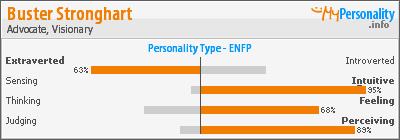
MyPersonality.info Badge

Click to view my Personality Profile page

MyPersonality.info Badge

Click to view my Personality Profile page
BusterStronghart@Gmail.com


Thanks to Mr. Google I discovered the meaning of "Liber scriptus proferetur,in quo totum continetur, unde mundus judicetur." Mozart's, Requiem.

Liber scriptus proferetur,
In quo totum continetur,
Unde mundus judicetur.

The written book shall be brought
In which all is contained
Whereby the world shall be judged.

If we write the book ourselves,
one would expect a lot of spinning of our story, and a heap of rationalization.

Sunday, December 28, 2008

BusterStronghart@Gmail.com

email exchange:

Dear St Eve my amazing friend,

I do not, and never have, consider your positions against capitalism to be "rants" or "bizarre." I have always taken them seriously. I realized long ago that you understood, much more than I, capitalism's harmful ramifications that are so easily overlooked by we. the selfish, who enjoy its benefits.

I do not think that I have a "life."

I understand and enjoy your buffoonery.

I am never certain of anything. I live in uncertainty and am comfortable here.

It am intrigued that MG seems to have become more certain of his views even as they change. I sense that you, on the other hand, have backed off the torque a little.

But I am not sure about my statements about either of you.

Truth is often found in cliches.

Is it still a cliche to say that violence leads to violence? Is it a cliche to say that those who will themselves to power are the most likely to engage in and justify violence?

If Gandhi and MLK were Palestinians how would they organize the situation?

mek


We all do have lives so there is no need to get one the question at this stage is how we spend the remainder. I prefer to entertain, play the buffoon and work on my little projects, rail against the tyrants and miscreants and laugh at the happening that my bizarre objections to capitalism and its deformed relative imperialism have all come to pass.
Note our brave Yiddish brothers are now bombing gaza. There is
a striking parallel to the Warsaw ghetto. We starved and strangled this tiny enclave they struck back and the Israelis bomb it and plan to level it. Shame shame on the nasty jewish hypocrites. With a small diminished j. With the Madoffs we join the biggest of the
of the wall street crooks and the Israelis we link arms with the
worst of the world oppressors. A schande on the jews as the NY Times points out. The christs are filled with glee and schadenfreude. Maybe we should all bust out israeli lapel pins
and strut around in yarmulkes with our pants unzipped and
our circumcised weddlers exposed chanting hurray for the jews.
ss

ss

Saturday, December 13, 2008

BusterStronghart@Gmail.com

The birds fly away
When the weather turns to autumn
In spring they return.

They fly, fly, fly,
Their wings carry them;

Suddenly you notice
That they already
Drink of the distant blue sky.

They fly so swiftly that one takes
Them as disappearing dreams.

What flies more swiftly
Than the birds? Life!

But, unlike the birds,
It never comes back.

…………………………………………..Adapted From “Satantango,” a Hungarian Film
BusterStronghart@Gmail.com

Far away, a man on the beach
With a flashlight.
What does he think about?

'Whatever death is
Life is worth more.'

You who are tied to me by friendship's chain,
And with whom together we kept
Wide awake so many nights;
You may want to
Mourn over my corpse.


But I say to my friends
Do not mourn me;
You know that with us
It was mostly laughs;

And mourning would strike
Against our normal selves.

But, for sure, come out to me,
And as you stand over my grave,
Cheerfully tell the jokes
We told ourselves.


And laugh some more
And mention all the old names
And know that your blood ran in mine;


---------------------------
Inspired by
Satantango, a Hungarian Film.

Monday, November 03, 2008

BusterStronghart@Gmail.com

On this earth there is one thing that is dreadful: Everyone has his reasons. Eugene Jarecki

Why We Fight - A Film By Eugene Jarecki

BusterStronghart@Gmail.com

Life can only be understood backwards; but it must be lived forwards. Kirkegaard

Monday, October 27, 2008

BusterStronghart@Gmail.com

If all this dying doesn't end soon everything will turn to shit. mek

Like most good Americans he was fervently materialistic and oblivious to the incongruity of wealth and poverty around him. (mek?)

"Music of Chance," Paul Auster: "Something was finished and something was about to begin. Each citizen carries the entire world within himself. "

"In the Country of Last Things," Paul Auster
"Make plans. Consider the possibilities. Act. Unless you learn to accept what has given to you , you will never be at peace with yourself. "

"The Book of Memory," Paul Auster
"It was. It will never be again. Remember. "

"Leviathan," Paul Auster
"Every man is a prisoner of his pecker."
"Once you turn against yourself, it is hard to believe that everyone is not against you too. "
BusterStronghart@Gmail.com

I count it as a mistake of our mistaken democracy, that every man who can read is allowed to believe that he can understand all that is printed.
BusterStronghart@Gmail.com

Many years ago I was standing at the urinal of a VFW in Skowhegan, Maine, when the man pissing next to me allowed that it was too bad that you had to pay for a drink and then piss it all away.

+++++++++++++

He bears the heaviest chain -- that of maturity.

++++++++

His smile was kept locked away in some small drawer somewhere in a cellar.

Friday, October 24, 2008

BusterStronghart@Gmail.com

There is a time of life when preferences and antipathies are easily implanted and grow to be ineradicable moral sentiments of maturer years.
Lord Salisbury 1865

Apparently after having been molded by friend Dr. Horowitz, few of us have been able to move our heads from side to side so that we could see the rest of the world.

Tuesday, October 21, 2008

BusterStronghart@Gmail.com

It seems to me that much of what we call Truth is tentative, subject to change.

Saturday, October 18, 2008

BusterStronghart@Gmail.com

Mike
This is beauifully written and a rare tribute to a friend. However, I disagree when you say Hal was surrounded by creative people but he wasn't one of them ..In my occasional get-togethers with Hal over the years we often talked about business, first his advertising work and later his role as producer/director of TV commercials. It was his job to be creative, and I think he did his job well.
John
BusterStronghart@Gmail.com

When I think about Hal I try to bring together each of the facets that made up his personality. He wanted to be outsize and memorable but he banged up against his limitations and couldn't bring himself to accept them. He was in a business surrounded by creative types but he wasn't one of them. He wasn't 'talent' but he wasn't a 'suit' either.

He kept his insecurities to himself, he was very closed, very private, so it is doubly hard to put him together in a written sketch. He hid so much of himself from us, and only occasionally, when he was bleeding, did we glimpse a little of what lived under his skin.

His self-protective shield was anger, not a blistering anger, but rather a blustering anger. I loved him for it. It was clear to me that he used his anger to keep himself separate from his life's accumulation of ticks and harrumphs, experience and memory.

When Hal dressed for his role -- the role he played before us, his audience -- when he prepared the fiction that became his self, his character, he dropped deep into his unconscious and the role he played actualized into himself, without deliberate intention, and therefore, paradoxically, into a genuine self. The man we saw on on stage was real.

He never told us that he was dying. We are not sure whether he knew it or whether he was in denial. By not telling us, he deprived himself (and us) of a farewell; we never got to tell him directly how much he meant to each of us, how important to us he was, and, most important, how much we loved him.

Friday, October 10, 2008

BusterStronghart@Gmail.com

Lifeboat an Alfred Hitchcock film with Walter Slezick ,William Bendix Tallula Bankhead directed by Hitchcock.Walter is the german uboat captain;Tallula ,the starlet. Slezack was committed to survive and secreted food while the others starved. I think Bendix who was wounded was weaked and unfit was killed by Slezak so they could conserve water. Lets all as survivors, the remaining beings in our lifeboat, commit to share the remaining supplies and nobody pushes anybody overboard.
ss

At the moment of death life stops -- and we will not know that our existence is over.

ss


What has HAl's death meant to us, personally and as a group. What did it feel like when realizing that the number of empty chairs for Greenberg, Aronsohn, Spencer and
Alas, as Hal's parting shot reminds us, we can not, like those in the movie, be saved from death. None of us can survive. Now what the fuck can we do about that? Make believe?

g

The emails before our meeting were thought provoking, the conversation outdoors at Henry's helped to add definition and clarity to the summation of our view of Hal but the ass kicker, the
post script to the story was Craig's revelations and additions to Hal's life and death story.
And then the renewed discussion after Craig's departure . Now there was brand new information which shed light on all the principle players and their motives. What a spectacular evening. Unrivaled in the annals of "Boys Of HM regular evenings out and about". A rare peek in to the clotted heart of a man who was overcome by disease and twisted disappointment in life and love.
Whether we understand it or not we have witnessed a very sad waste of human potential and it ain't over yet.
ss

When Gross pointed to the places, "over here," for Aronsohn, and "that place" for Spencer, and "this place for Danny, and Hal, by me; for a moment, I felt as though each were present. Something broke the spell, someone said something too soon--maybe it was Hal....

All worlds change and vanish. It looks as though our's is vanishing now. I have had enough of change. Lets think of another way our only experience is life. We will not experience our death. We may be bailing as fast as we can; but there's no one who can repair the leak in the lifeboat. The odd, strange thing is that we will each carry on, mostly ignoring the dead end in our future, until we arrive it --and then we won't know it.

mek

Lets think of another way our only experience is life. We will not experience our death. Death is
this then when there is no more life. Only the survivors will experience our absence of life.
If you want an afterlife ,a second installment then there are alot of good stories out there. Learning everyday how to live fully in the present. That is it a finite number of present moments
till the last one. The biggest economy to prolong the number of present moments in which to live is sleeping less. That gives me more real added time not hopeful fairy tales.
ss

Tuesday, September 30, 2008

BusterStronghart@Gmail.com

My life-long friend Hal died on September 26. So I looked up "friend" in a few books of quotations. Some fit, some don't.

"Friend: a single soul dwelling in two bodies." Aristotle -- not Hal and me, no we were certainly not a single soul.

"A friend is, as it were, a second self." Cicero -- could be. Hal had some attributes that I would have liked to have had. His quick wit. His ebullient self-confidence. (Well, he really wasn't self-confident, but rather, he knew how to act with confidence.

"A friend is a present you give yourself." Robert Louis Stevenson...could fit. He was someone whom I always enjoyed being with. Lots of laughs.

Well, none of those ideas about friends exactly fit my relationship with Hal. Ever since I knew him when we were 13 or 14 he was angry and had a hostile wit...I never figured out his source of anger but it was deep and inbred. I knew both his parents--is mother was warm and very beautiful brunette, and been a B-Movie actress in the thirties; his father was a very wealthy man, but a little distant.

Hal had been adopted by his father. Hal was actually the son of what used to be called a "butter and egg man," who is buried in Washington Cemetery in Brooklyn, off Ocean Parkway. I never learned his name. Something in me remembers Hal referring to Breakstone Cottage Cheese, but I don't know whether that's my faulty memory or Hal's imagination. Who knows? It might even be my own imagination's eagerness to build a story.

As a boy Hal valiantly went out for football and warmed the bench with me, rarely, if ever getting into a game. He was afflicted with the flattest feet his doctor had ever seen; but that did not dissuade him from going out. Coach Quinn kept him on the team mainly because Hal was an inspiration to us all, running laps with his guts falling out, but persevering when others quit, and always finishing the required number of laps, even as night fell on the track.

He told us that he went out for football at Michigan. Of course, he never expected to make the team, at least I think he never expected to make the team, but with Hal one never knew what his expectations of himself actually were. He didn't make the team, but he went out.

After college his father offered him the family business. Hal turned it down. He wanted to be in show business and so he took an usher's job at the Ed Sullivan Show on CBS. Imagine, turning down a fifty-thousand dollar job that was guaranteed to lead to the ownership of a huge company--but Hal was true to his heart. Show business it would be and he took an ushers job.

Somehow, that lead to advertising where Hal eventually was responsible for directing and producing many of the Procter & Gamble and Timex television ads for Grey.

Later he opened his own production company, Randelman Productions, and Grey continued to use him because of his extraordinary abilities. He was proud of being a "producer," and being able to pull thnigs together when other people couldn't. He won a Cleo or two, but never bragged about it.

Hal was proud of knowing the "right places." Whether it was travel or dining, I could count on Hal to tell me where to go...

Saturday, September 13, 2008

BusterStronghart@Gmail.com

This is what I wrote on June 15, 2003. That is what I am doing today.


Sunday, June 15, 2003
My job today is to re-file or toss all of my files. At present I have laid them all out on my dining room table in an effort to sort them. Looking at the mass of materials is making me very anxious. Bloggerbasic still hasn't answered me about sprellschek.
# posted by Buster Stronghart @ 1:22 PM
BusterStronghart@Gmail.com

What I don't know of a subject I fill in with an imagined rainbow of facts, distant from the subject at hand, somewhat hazy, and yet fulfilling a general need for knowledge--whether accurate or not.

---

I am one of those men who keep a running ledger of losses.
BusterStronghart@Gmail.com

I want an attorney who is prudent and wise, and provides me with deliberative counsel.

Here's to us
Who's like us?
Damned few.
And they're all dead!

I want to afflict the comfortable and comfort the afflicted.

I know a man who clings steadfastly to an ever changing set of principles.

If your mother says she loves you demand a second source.

He gazes back with nostalgia to a world that never was.

I have read so many books that promised to change my life. -- But none have.

My adolescent dreams follw crooked paths. Empty prayers dwindle.
BusterStronghart@Gmail.com

Personal liberation is finding the courage to live your own life.

But she made me feel that I existed only in her. -- and I did.
BusterStronghart@Gmail.com

Great truths are often contained in small absurdities.

Elements of continuity outweigh the elements of change.

Thursday, August 28, 2008

BusterStronghart@Gmail.com

"Be sure to read no mean books. Shun the spawn of the press of the gossip of the hour. Do not read what you shall learn, without asking, in the street and in the train."

Ralph Waldo Emerson.

Sunday, August 24, 2008

BusterStronghart@Gmail.com

Was it you?

You think I forgot

The iron bed

and those yellow sheets

The whiskey bottle on the night table

The quiet music coming from

The next room. Your clothing

on the floor, A fragrance of

only you.

Whispers coming from the leaves

Of the oak tree at the window

And your whispers, too, in my ear,

Did I bite or was it you?

That, at last, I have forgot.

MEK

Aug 2008

Sunday, August 17, 2008

BusterStronghart@Gmail.com

Dear Scott:

Thanks for giving me all these examples of what a billion is. And also thanks for reminding me about all the taxes I might pay if I had any money , liked to go fishing, or were in certain businesses.

But when you tell me that that things were better 100 years ago, and that mothers stayed home and watched the children, I ask you--was that in a beach front apartment at Southpoint or the Hermitage? Are you saying that our grandparents and parents had an easier life than we have?

Did they live on the beach and go out for dinner 4 or 5 times a week? Did your grandparents even have a telephone on which to press 1 for English? Did they take vacations, go to Europe, go on cruises? Did they collect social security checks and did they have medical insurance or Medicare?

One hundred years ago was 1908. The 16th Amendment authorizing the income tax was passed in 1913. Before that we had an income tax during the Civil War and during the Spanish American War.

One hundred years ago we still had the 60 or even 72 hour week, there was no Workmans' Compensation, Child Labor Laws were far in the future, people lived in tenements without plumbing. Many of our grandparents and great-grandparents worked in sweatshops six days a week and seven days during the season--that meant both mother and father. Piece work was taken home where all the family worked on it including five year olds. None of them had tax problems.

If you worked on the railroad and in most other industries, and had an accident you were merely dropped from the payroll. There was no sick pay and no paid holidays. No one even heard of vacations. Children died from bad milk, tuberculosis was rampant, the streets reeked with garbage, and most people were crammed four, five and six in two rooms. The toilets (outhouses) were still in the backyards of the Lower East Side. But there were no tax problems.

It's hard to believe but many Jewish women turned to prostitution. Yes, don't say no. They didn't pay taxes either.

Newspapers were published in dozens of immigrant languages because most immigrants didn't speak English. Not only didn't they speak English, but also they paid no taxes.

Do you really think that things were better when all the taxes that were enumerated didn't exist?

Here's what my grandfather had to say about taxes when I complained to him about all the deductions on my paycheck:

"Michael, in Russia there were no taxes. We paid nothing. But every spring the mud was up to our knees--and that was INSIDE the house. ...Here there's no mud--so pay your taxes and stop your whining."


Mike

Friday, August 15, 2008

BusterStronghart@Gmail.com

Joe G: Don't piss in my face and tell me it's raining.

Joe G: I don't mind when you shove an umbrella up my ass--but when you open it and twirl it around--
BusterStronghart@Gmail.com


Change yourself--not the world.

Thursday, August 14, 2008

BusterStronghart@Gmail.com

Worry is a substitute for action.