Saturday, February 21, 2009

BusterStronghart@Gmail.com

Early this morning I woke and as I reached for my glasses on the night table so that I could read the clock that turned out to indicate 3:30, I recalled a dream involving a group of men and one woman who came to the drug store regularly to send Western Union Money Transfers. At the time, there was a government regulation that transactions of $10,000, and more should be reported to a government entity--which one escapes me.
Each of the transactions brought to me by this group were under $10,000, usually between $8,500 and $9,500. After the first few transactions I realized that this must be a group of drug dealers, probably marijuana, but then I really wasn't expert enough that I could discern the difference between marijuana dealers and heroin or cocaine dealers.
The money would always be brought by a single member of this group of four or five people, and after a while I decided that it would be safer to accept the cash only at the bank, where I would deposit it before actually sending the money transfer. The group readily accepted this arrangement, as they (or their leader) understood the danger to which I was exposed when I kept the money in the store and brought it to the bank.
These transactions were very profitable for me, bringing me commissions of $130 to $150 each. There would be three or four transactions each week, and they were a factor in the on-going success of my store. By success I mean the ongoing prevention of failure or bankruptcy.
In time I discerned a pattern. Always there would be a transaction on Monday afternoons. The others would be made irregularly but never on Sundays. After Mondays there would be two or three more. I became very interested in or perhaps intrigued by in the group, and wondered what they were actually doing,--were they wholesalers, what was their product, who was actually in charge, was the person in charge one of the people who brought me money? I wondered.
A time came when I was at Estrella de Ponce a bar on Broadway in Bushwick, at that time one of the seedier parts of Brooklyn, much more so than the part of Williamsburg in which my store was located.
I knew the owners of the bar, as they were my customers at the drug store. Their names were Tonto and Luis, and they were trying to interest me in a real estate deal, which, of course, I passed on; but which, of course, would have made my life much easier to day. Tonto now lives in Sands Point and Luis and his wife live on Riverside Drive. So you can understand what kind of partners I might have had. I led them to my friend Ruben, the architect, but as far as money was concerned, he was already over his head due to his attraction to cunt, cocaine, and cognac, and he passed also. -- Only one of many mistakes for both of us.
While I sat at a table with Tonto and Luis, three members of the group entered the bar. They sat at the bar and ordered tequila, and seemed very happy about something that had occurred that very day. They spoke in Spanish far too quickly for me to understand, but Tonto, a perceptive man if there ever was one, understood that my attention had been diverted, that it had left the table at which I sat, and that I was carefully watching and attuned to the men at the bar.

Tonto cautioned me not to watch so closely. "Why not?" I asked. He explained that they were very dangerous men, that they controlled the neighborhood and that they were not to be toyed with. Two thoughts immediately came to mind. First, that I had nothing to fear from these men, as I was one of them. Second, that my innocent naivete would continue to protect me--as it always had.
In my mind, there was never a question of reporting them. When I began to write to write this piece I described it as a "dilemma" but a dilemma occurs when there are difficult choices to be made. In this case, there were no choices--I knew that I would continue my service to the group.
Should I have used the phrase "my part in the crime," instead of "my service" to the group?

Friday, February 20, 2009

BusterStronghart@Gmail.com

How twisted, perverse we are. We pretend to be simple, plain, ordinary, normal--but, oh, if only you could see under our skin, you would know how twisted, what liars, how selfish, and unthinking we really are.
BusterStronghart@Gmail.com

We would be a better, more peaceful society were there a little more constructive ambiguity, and a deeper hypocrisy....

mek

Tuesday, February 17, 2009


BusterStronghart@Gmail.com
Posted by Picasa
BusterStronghart@Gmail.com

Mike
This is beauifully written and a rare tribute to a friend. However, I disagree when you say Hal was surrounded by creative people but he wasn't one of them ..In my occasional get-togethers with Hal over the years we often talked about business, first his advertising work and later his role as producer/director of TV commercials. It was his job to be creative, and I think he did his job well.
John

BusterStronghart@Gmail.com

When I think about Hal I try to bring together each of the facets that made up his personality. He wanted to be outsize and memorable but he banged up against his limitations and couldn't bring himself to accept them. He was in a business surrounded by creative types but he wasn't one of them. He wasn't 'talent' but he wasn't a 'suit' either.

He kept his insecurities to himself, he was very closed, very private, so it is doubly hard to put him together in a written sketch. He hid so much of himself from us, and only occasionally, when he was bleeding, did we glimpse a little of what lived under his skin.

His self-protective shield was anger, not a blistering anger, but rather a blustering anger. I loved him for it. It was clear to me that he used his anger to keep himself separate from his life's accumulation of ticks and harrumphs, experience and memory.

When Hal dressed for his role -- the role he played before us, his audience -- when he prepared the fiction that became his self, his character, he dropped deep into his unconscious and the role he played actualized into himself, without deliberate intention, and therefore, paradoxically, into a genuine self. The man we saw on on stage was real.

He never told us that he was dying. We are not sure whether he knew it or whether he was in denial. By not telling us, he deprived himself (and us) of a farewell; we never got to tell him directly how much he meant to each of us, how important to us he was, and, most important, how much we loved him.

Monday, February 16, 2009

BusterStronghart@Gmail.com
It's been a struggle all weekend I want to write as accurately as possible. I want to let you know how I feel and what I saw, but it's hopeless. I can't dig up the preciseness that I'd like to.

Yes, it's hopeless, and I know that no one will understand--that is if I could actually say the truth...So, preciseness and the truth each elude me.

But what follows is a listing of facts (as I know them, mostly through Phil)

Ah yes. That venom.
1.Carl and Nonine, Phil's children, had a trust set up by their grandparents (Phil's parents) that Phil invaded-- in fact, completely stripped. There was zero money in it at Phil's death.

2. Moni was Hal's second wife. She was unfriendly toward
Carl and Nonine from the very beginning, going as far as not permitting them to live in the apartment in Boston where Phil lived with Moni. According to Phil, the children lived alone in an apartment on Beacon Hill after Phil's first wife, Brenda, left them in the apartment and took off for North Carolina with an orthodox Jew. (But that's another story and I don't know the details.)

3. Carl had a very early script writing success in California. According to Phil, he spent all the money within a year or two including a wedding in Venice that Phil alleged cost $250,000. But after his early success with two scripts (never filmed, but bought and paid for) Carl never sold another script. Never.

4. Therefore, young Carl was a constant financial drain on Phil, that led Phil to rationalize stripping the trust, and further, caused a rift between Phil and Carl. Phil ended up loathing Carl.

5. Carl found out about the Trust stripping only after Phil's death. He looked to Moni, a woman he had always despised (that's one thing that Phil and Carl had in common) for relief. None was forthcoming.

After the funeral, the old friends, went to Oeste where Carl walked in by chance. I called to him and he sat with us and spewed the aforementioned venom all over the table, over our food and onto my lap and even my shoes. Worse, he did not pay for his drinks.

6. Moni received Phil's entire estate including
Carl and Nonine's Grandmother's very high end antique furniture, jewelry, china, and gold flatware. According to Carl Moni shared none of it. I suspect that some or all of the money went to the purchase of the condo in Hancock Park, or as Phil would say, "Beverly Hills adjacent." So Moni got all that plus the house in Hancock Park & the house in the Adirondacks.

7. I cannot understand why Phil did not write or amend a proper will. Phil admired himself for his "producer values." "producer values" meant that he took care of everything, and made sure that there were no loose ends.

8. Moni died five weeks after Phil. She had inherited everything. She gave that "everything" to her relatives and friends. Nothing to Carl, nothing to Nonine . Not even a memento.

9.
Carl (and Nonine?) are suing Phil's Estate and Moni's Estate.

10. Basically I take Carl's point of view--Two of the friends think that Carl is a low-life. (Those unpaid drinks, I guess.) Another is quiet on the issue. Carl might be a low-life but he is still right.

11. I told Carl that he has script made of gold here and that he should start writing it. He says he is too close to the situation right now. I replied that the cliche that you should write what you know is a cliche because of its essential truth.
mek

Friday, February 13, 2009

BusterStronghart@Gmail.com

You have to know what you want most. No one can have everything or be everything so you have to try for what you want most and you have to start early. If you go in the wrong direction sometimes it's too late and you can't go back.
Mae West

Sunday, February 08, 2009

BusterStronghart@Gmail.com

Faraway and nearby is in my heart always
Everything contained but everything free
Pennies and diamonds linked with that
Love over all that calls and pushes
And at last binds.

..............mek Feb 2009

Saturday, February 07, 2009

BusterStronghart@Gmail.com

You know,
It's people who complicate life.

Life is surprisingly simple.


Late Autumn
Yasujiro Ozu


Wednesday, January 21, 2009

BusterStronghart@Gmail.com

It's finished
It's all over
Over
And there won't be another
It won't be good
Ever again
Maybe never more
It's like a nightmare

Where is somebody new?
Where will he come from
If he comes?
Or won't he come ever again
Maybe never more.
Take it or leave it.
What can you do?
You lse your words
Yet you cannot go.
It's been over long ago,
It's good there's Shangri-La,
...Good to know
I won't be here long.
Take it or leave it.
Say, Honey, Why?
Why must it be over
...over now?

And there won't be another
And it won't be good
...ever again.
Maybe never more.
He's got my soul
Things are going his way
Without him this world is barren..
With him life is full and happy.
How could it be over?

Silly

Never again,
maybe never more
...It's over
There's no end
No end now
It can't fade...
Ever again
Never Maybe
Maybe never more.

From the film, "Damnation" Bela Tarr, a Hungarian director.

Sunday, January 18, 2009

BusterStronghart@Gmail.com

This was another time. She was sitting on the window seat, letting the sunlight warm her body through the navy blue sweater she wore. The book was in her hands, it was a little heavy for her, and I came over so that I could look over her shoulder and see which chapter she was reading. She was already about three-quarters through and was struggling with the poetry which was far too allusive for her. Annoyingly allusive, I say, because you know, don't you, that some writers try to impress us with their erudition. Childish and reflective of an undeveloped ego, I would say.

Anyway, she was sitting primly, her legs crossed, her red hair glinting in the sunlight, and I couldn't resist touching the back of her collar with my fingers which she felt, and when she looked up at me I stretched my finger into her collar, along her neck, just under her hairline. Her eyes widened for a flash, then, she waited, still prudent, unwilling to acknowledge my indiscretion nor to encourage me to continue.

Saturday, January 17, 2009

BusterStronghart@Gmail.com

She told me of her cowboy, riding on the Texas plain, tight lipped, soft-spoken, a man whose sex was silent and polite, crafted by the sure knowledge of strong, experienced hands, their coarseness, she explained, leavened by his soft ways.

He was true in ways that she couldn't be, and his hurt was written in the far-away gaze he came to have when they were together. His eyes were narrow, permanently sun-squinted, and steel gray, not yet skeptical, but, because of her, unfortunately, soon to be cynical.

I was angry with her, and I couldn't resist saying, "every woman has a cowboy in her past--you're only one of many.

mek
BusterStronghart@Gmail.com

"At a lyceum, not long since, I felt that the lecturer had chosen a theme too foreign to himself, and so failed to interest me as much as he might have done. He described things not in or near his heart, but toward his extremities and superficies. "
Thoreau, "Life Without Principle"

Write what you know!

Saturday, January 10, 2009

BusterStronghart@Gmail.com

The Palestinians have done and continue to do everything possible to lose the peace. In seeking what they consider to be perfect justice they have destroyed or made miserable two or three generations of their own children.

There seems to be no "compromise" gene in their leadership. I feel very sorry for the Palestinian people.

My heart, however, lies with the Israelis who, I admit, are far from perfect themselves. Their insistence on settlements is a continual provocation, their treatment of Palestinians is a desecration of their own morality and ethics.

Both sides have fanatics, but the Palestinian move to terror since the sixties has proven to be self-defeating. It is they who have engendered the terroristic strategy of killing innocents that runs rampant in the world today.

Considering that Palestinians and Jews are genetically cousins, think what progress could have been made in science, agriculture and business if they had been working together instead of this madness.

Hamas prefers death, mayhem and destruction to solutions.

Get rid of their leaders--bring in new ones who actually want peace by compromise.

Thursday, January 01, 2009

BusterStronghart@Gmail.com

A few more missing persons who I would like to see again:

Harold Ruderfer
Bob Berman
Ernie Wyre

First, you should understand that Auld Lang Syne means something like: For Old Times Gone, or, long, long ago, or, for old times sake, or, the good old days-- or, for the sake of the good old days.

Should old acquaintance be forgot
And never brought to mind?
Should old acquaintance be forgot,
and those good old times...

For auld lang syne, my dear
for auld lang syne,
we'll take a cup of kindness yet,
for auld lang syne.

And surely you'll buy your pint,
And surely Ill buy mine!
And we'll take a cup of kindness yet,
For auld lang syne.

We two have run the slopes,
And picked the daisies fine,
But we've wandered many a weary foot,
Since auld lang syne,

We two have paddled in the stream,
from morning sun till dinner,
But seas between us broad have roared
Since auld lang syne.

And there's a hand my trusty friend,
And give us a hand of thine!
And we'll take a right good will draught,
for auld lang syne

mek
BusterStronghart@Gmail.com

New Years Day Tradition


For Ernie Wyre, RIP and Father Robert Earl Hood, RIP

Hoppin' John

Ingredients:
1 pound dried black-eyed peas
2 small smoked ham hocks or meaty ham bone
2 medium onions, divided
3 large cloves garlic, halved
1 bay leaf
1 cup long-grain white rice
1 can (10 to 14.5 ounces) diced tomatoes with chile peppers, juices reserved
1 medium red bell pepper, chopped
1/2 green bell pepper, chopped
3 ribs celery, chopped
1 jalapeno or serrano pepper, minced
2 teaspoons Cajun or Creole seasoning
1/2 teaspoon dried thyme leaves
3/4 teaspoon ground cumin
3/4 teaspoon salt
4 green onions, sliced

Preparation:

In a large Dutch oven or kettle, combine the black-eyed peas, ham bone or ham hocks, and 6 cups water.
Cut 1 of the onions in half and add it to the pot along with the garlic and bay leaf. Bring to a boil, reduce the heat to medium-low, and simmer gently until the beans are tender but not mushy, 2 to 2 1/2 hours.
Remove the ham bone or hocks, cut off the meat; dice and set aside.
Drain the peas and set aside.
Remove and discard the bay leaf, onion pieces, and garlic.

Add 2 1/2 cups of water to the pot and bring to a boil. Add the rice, cover, and simmer until the rice is almost tender, about 10 to 12 minutes.

Mince the remaining onion then add to the rice along with the peas, tomatoes, and their juices, red and green bell pepper, celery, jalapeno pepper, Creole seasoning, thyme, cumin, and salt.

Cook until the rice is tender, 5 to 8 minutes. Stir in the sliced green onions and the reserved diced ham.


Serve with hot sauce and freshly baked cornbread.

Diana Rattray, About.com
BusterStronghart@Gmail.com

A few missing persons who I would like to see again:

Peter Spencer
Hal Randelman
Mary Randelman
Danny Greenberg
Richard Aaronson
Bob Hood

my Dad
my Mother
Uncle Max
Aunt Sylvia
Grandpa
Grandmother Iverson

Danny and Moe
Willie the Moose

January 1, 2009

to be continued...

Monday, December 29, 2008

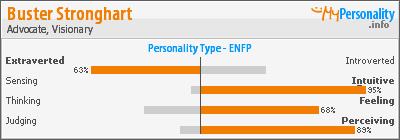
MyPersonality.info Badge

Click to view my Personality Profile page

MyPersonality.info Badge

Click to view my Personality Profile page
BusterStronghart@Gmail.com


Thanks to Mr. Google I discovered the meaning of "Liber scriptus proferetur,in quo totum continetur, unde mundus judicetur." Mozart's, Requiem.

Liber scriptus proferetur,
In quo totum continetur,
Unde mundus judicetur.

The written book shall be brought
In which all is contained
Whereby the world shall be judged.

If we write the book ourselves,
one would expect a lot of spinning of our story, and a heap of rationalization.